
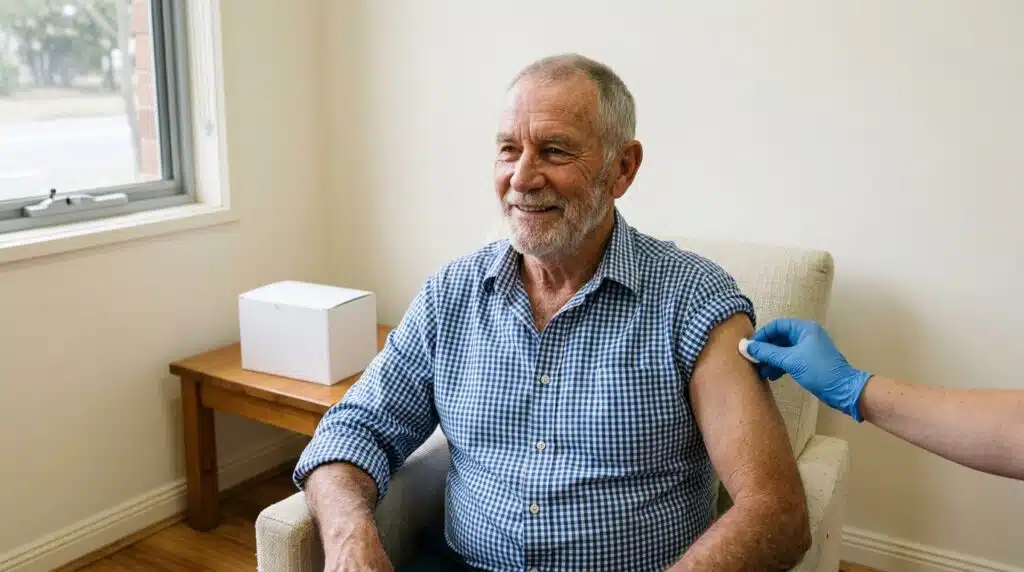
Shingles vaccine eligibility under the national program comes down to three questions: how old you are, whether you are Aboriginal or Torres Strait Islander, and whether a health condition or treatment has weakened your immune system. This guide works through each group, explains the catch for anyone who once had Zostavax, and sets out your options if you fall outside the funded list, so you know where you stand before you visit us for a shingles vaccine in Abermain.
Key Takeaways
- A free 2-dose course of Shingrix covers people 65 or older, Aboriginal and Torres Strait Islander people from 50, and some adults from 18 with a weakened immune system.
- If your earlier Zostavax dose was government funded, free Shingrix opens up 5 years after it.
- Healthy adults from 50 are still advised to be vaccinated, but pay for it privately.
- Check your record in myGov before you come in so the pharmacist can confirm your status quickly.
How the free shingles program works
Free Shingrix is paid for through the National Immunisation Program (NIP), which the Australian Government reserves for people at moderate to high risk of severe illness and complications from shingles. When you qualify, both doses of the course are funded.
To receive NIP vaccines free, you need to have, or be eligible to have, a Medicare card. Community pharmacies that join a federal program called NIPVIP can give free NIP vaccines with no out-of-pocket costs to eligible people aged 5 and over. Ring Abermain Chemist on (02) 4930 4442 to check how that applies to your visit.
Which groups qualify, at a glance
The table below sorts adults by whether the Government funds their vaccine or whether it is recommended without funding. Each line comes from the Australian Immunisation Handbook zoster chapter.
| Who | Recommended? | Free under the NIP? |
|---|---|---|
| Anyone 65 years or older | Yes | Yes |
| Aboriginal and Torres Strait Islander adults 50 and older | Yes | Yes |
| Adults with moderate or severe immunocompromise on the funded list | Yes | Yes |
| Other immunocompromised adults | Yes | No |
| Healthy adults aged 50 to 64 | Yes | No |
Younger adults with immunocompromise
Illness or medicine that lowers immunity brings higher rates of shingles, sometimes at a younger age. For that reason, the Handbook keeps a detailed list of conditions and therapies that attract funding. Examples on it include:
- blood cancers such as leukaemia, aggressive lymphomas and multiple myeloma
- chronic kidney disease at stage 5 or on dialysis (stage 4 and below is not funded)
- HIV with a CD4 count below 200
- an autologous stem cell transplant or CAR T-cell therapy, currently or within the previous 24 months
- many immunosuppressive, biologic and transplant anti-rejection medicines, typically if still being used or stopped in the past 6 months
The list notes that not every condition which raises shingles risk is included, and eligibility often hinges on a funded time window after treatment. If you start the course inside that window, the second dose is still funded when it falls later. Your specialist or GP is the best person to confirm where you sit, and the Handbook advises vaccinating ideally before immunosuppression begins.
At a pharmacy in NSW, the pharmacist vaccination standard allows the Shingrix brand only, for people 18 years and over.
Not sure which row of the table fits you? Give us a ring and a pharmacist can talk through your age, history and records before you walk in.
The Zostavax five-year rule
Before Shingrix, older Australians were offered a live vaccine called Zostavax. According to the Handbook, its protection wanes significantly from around 5 years after vaccination, which is why a follow-up with Shingrix makes sense for many people.
How you paid for that earlier shot changes your eligibility. A government-funded Zostavax dose means you wait 5 years from that date before Shingrix becomes free. If you bought Zostavax yourself, the waiting period for funding does not apply, and you can have free Shingrix once you meet the age or health criteria. In every case, at least 12 months should pass between the two vaccines, and you still need both Shingrix doses.
Check your record before you visit
Not sure when, or whether, you had Zostavax? Every dose given in Australia goes onto the Australian Immunisation Register. Services Australia explains how to download an immunisation history statement through your Medicare online account in myGov or the myGov app. No online access? A vaccination provider can print one for you, or you can phone the register on 1800 653 809, Monday to Friday 8 am to 5 pm.
When you come in, bring photo ID, your Medicare card and that statement. Having the dates on hand lets the pharmacist confirm your eligibility without guesswork.
What if you are not on the free list?
Missing out on funding does not mean the vaccine is wrong for you. The Handbook recommends zoster vaccine for all immunocompetent people once they turn 50, and for immunocompromised adults from 18. It also suggests that people in their 50s or older who live with an immunocompromised person take that into account, because vaccination gives the household member some indirect protection.
The Handbook notes that Shingrix is registered for use in adults 50 and above, and in younger adults at increased risk. Anyone in those groups who is not funded can be vaccinated as a private patient. Phone us to check the current cost before you commit.
Frequently asked questions
Will I need a booster years from now?
Not at this stage. No booster is recommended, and the Handbook reports good protection at 10 years after two doses. Advice will be reviewed if data shows protection fading.
Can I have Shingrix with my flu shot?
Yes. The Australian Technical Advisory Group on Immunisation (ATAGI) advises it may be given at the same visit as any influenza vaccine, and alongside other non-live vaccines such as COVID-19 or pneumococcal. There is potential for more mild to moderate reactions when several are given together. Read about our flu vaccine service if you want both.
I missed the window for my second dose. Do I start again?
No. The Handbook says a gap longer than the recommended interval does not appear to reduce effectiveness, so the course simply carries on where it left off.
Do I need a blood test first to prove I had chickenpox?
No. Testing for immunity is not recommended before or after zoster vaccination. More than 97% of people in Australia carry antibodies to the virus by age 30, even if they do not remember having chickenpox.
Worked out that you qualify for free Shingrix, or ready to pay privately? Call ahead or walk in to 193 Cessnock Rd with your ID, Medicare card and immunisation statement.